Politics as spectacle and symbolic ritual
M: Son of the CenturyPolitics as spectacle and symbolic ritual is the public staging of political identity through shared symbols, organized movement, ceremony, and performance. In the book, such displays do more than represent existing loyalties: they make divisions visible, mobilize participants, and invest leaders and the dead with political meaning. A flag raised over a civic building, a funeral procession, or a crowd moving in formation can become both a claim to authority and a preparation for action.
Symbols and the staging of conflict
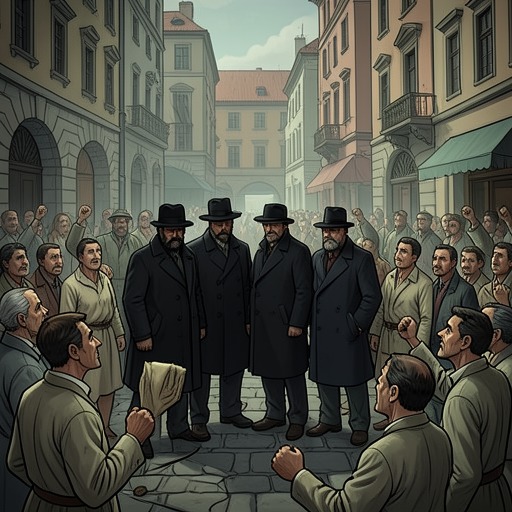
At the Milan demonstration of April 15, 1919, a breakaway group of several thousand demonstrators moved from the rally toward Piazza del Duomo. The scene became a contest between two processions and two political imaginaries. At the head of the socialist column, women carried a portrait of Vladimir Lenin and a red flag; their march was presented as a collective demand for a better life. Opposite them stood a smaller group of officers, Arditi, and Futurists, whose recent experience of war shaped a different relation to violence. The brief confrontation that followed made the political division physically visible: the socialist marchers’ rocks and clubs met gunfire from the other side. The procession had become more than a demonstration; its participants were assigned opposing roles in a conflict that allowed little room for neutrality.
The book also shows how Fascist organizers used symbols to turn political presence into a public test of allegiance. In Bologna, Leandro Arpinati led an attempt to place the tricolor on the municipal building; after that effort was repelled, Fascists fired at a socialist newsstand. On the anniversary of Italy’s victory in the Great War, Arpinati entered Palazzo d’Accursio and displayed the flag, then helped ring the great bell from the tower of Palazzo del Podestà. The ensuing procession carried flags through the streets as bells sounded. Fascists demanded public gestures of respect for the flag, and their parade converted that demand into a visible exercise of power. The sequence connected a national symbol to control over city space and everyday conduct.
Ceremony, memory, and political authority
Rituals of mourning also turned memory into a political resource. At a gathering on the Campidoglio, Gabriele D’Annunzio appeared with a large tricolor draped over the balcony railing and around the body of Giovanni Randaccio, his friend, who had died in an assault during the tenth battle of the Isonzo. D’Annunzio presented the flag as an object connected to the dead soldier, recalling that it had served as a pillow for the dying man. He then called for flags to remain in mourning until Fiume and Dalmatia were returned to Italy. In this performance, national grief was not directed toward closure: the displayed flag linked a soldier’s death to an unresolved political demand.
Fascist funerals likewise made remembrance an instrument of continued mobilization. After the deaths of three Fascists, their funeral was arranged as a solemn public ritual, but the ceremony was explicitly oriented toward vindication rather than putting the dead behind the living. The procession’s return to the streets in formation, with songs and the participation of sections of Ferrara’s bourgeois public, carried the ceremony’s political meaning into the city. The dead were presented not simply as individuals to be mourned but as figures whose memory justified action by the living.
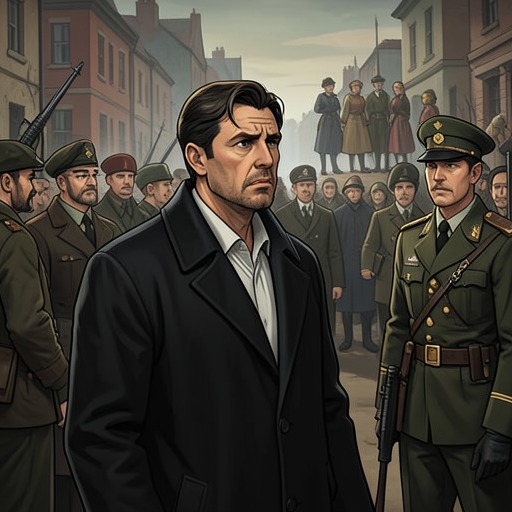
The funeral of the victims of the Milan theatre bombing gave Fascist display a larger urban stage. Twenty people had died and eighty were wounded. The state funeral used only the Italian tricolor, while a column of two thousand Fascists marched behind the coffins. They had already attacked the offices of Avanti! and an anarchist newspaper, presenting retaliation as their answer to the deaths. Their disciplined appearance in the streets of a working-class city made the procession a public demonstration of strength as well as mourning. At the cathedral, Benito Mussolini stood at the head of the squads as the Archbishop blessed the dead: the juxtaposition placed Fascist political authority before a religious ceremony and a national crowd.
Mass participation and organized power
Spectacle in the book is not limited to flags and ceremonies. It also depends on the capacity to assemble people and move them through public space. In May, thousands of impoverished farmworkers began traveling toward Ferrara at midnight, on foot, by bicycle, in wagons, and on barges. By the next morning, fifty thousand had entered the city in an organized column. The mobilization occupied and paralyzed Ferrara: telephone lines were cut, schools requisitioned for lodging, and shops and businesses closed. The immense display of numbers depended on networks in the countryside and on the practical arrangements that brought people together. Its scale made the rural population’s presence impossible for the city’s authorities and bourgeois residents to ignore.
This mass action took place against a background of intense organization in the countryside. In Emilia, socialist leagues and allied organizations influenced municipal government and controlled important parts of agricultural work, including hiring, work shifts, and crop decisions. The leagues’ reach shows that public political appearances were connected to material relations and organizational structures, not just to slogans or leadership. Ferrara’s Fascist mobilization similarly relied on provincial organizers, local groups, and logistical resources. The spectacle of a crowd therefore revealed—and tested—the networks capable of assembling it.
A different kind of collective action emerged during the legalitarian general strike announced for August 1, 1922. The Labor Alliance presented the strike as a joint defense of political and union liberties. Its declaration framed the confrontation as a final effort at resistance, while the Fascists issued an ultimatum to the state and claimed the right to act if the government failed to demonstrate authority. In this contest, declarations and deadlines were themselves public political performances: each side sought to show its capacity to speak for organized constituencies and to compel a response.
Ritual, leadership, and contested memory
The public review of Fascist forces in Bologna made spectacle an explicit display of command. After the socialist administration was dissolved, uniformed formations, cyclists, motorcycle patrols, youth groups, women’s groups, and bands paraded through the city. In front of San Petronio, the young squads passed Mussolini as he stood in an open car and saluted them. Bells rang from the tower of the Podestà. Yet the display also exposed a tension in Fascist power: the book emphasizes that Bologna’s local strength belonged to leaders such as Arpinati and Dino Grandi, not simply to the visiting Mussolini. The spectacle presented him as a leader before a massed movement while revealing how much that movement depended on regional figures and organizations.
The burial of the Unknown Soldier in November 1921 gave national mourning a unifying ritual form. A soldier chosen by lot represented the many dead, and the marble coffin became the focus of public prayer and commemoration. Five days later, the founders of the National Fascist Party, with Mussolini at their head, knelt for more than half an hour at the tomb. The scene joined a national ceremony of remembrance to Fascist political identity, making the soldier’s anonymity a powerful symbol of collective loss.
The return of Giacomo Matteotti’s remains to Fratta Polesine in August 1924 presents another public ritual, shaped by his wife Velia Matteotti’s wish for burial in his home region rather than a political funeral in Rome. Peasants, workers, and railway workers gathered along the route and in Fratta, where the ceremony was attended by tens of thousands. The procession and burial gave public form to demands for justice and retribution. Across these episodes, ritual does not resolve political conflict: it gives competing groups a language of belonging, grief, authority, and action, while the same streets, flags, bells, and funerals remain open to rival claims.